
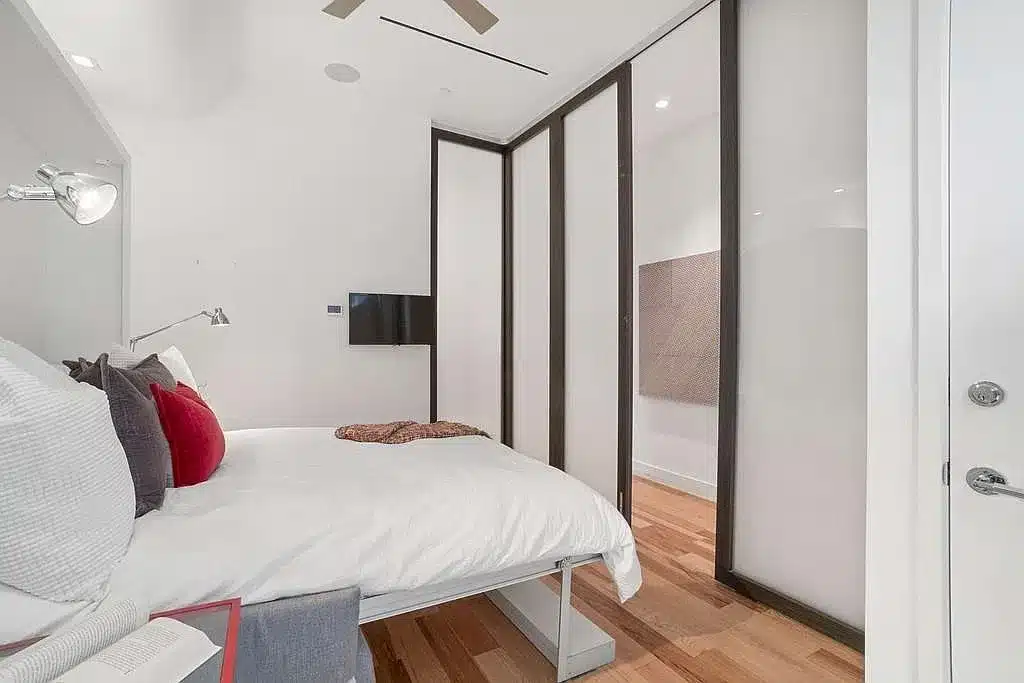
Mastering the terminology: a guide to space division

Whether you’re designing a hotel lobby, creating private office zones, or dividing a restaurant banquet room, one challenge is universal: the nomenclature.
Specifying the right system is demanding enough without having to decipher unfamiliar industry jargon. Understanding the basics of these terms can help you spend more time searching for the right solution for your space, rather than the right word to describe it.
Let’s start with the most basic question. What is a room divider?
What is a Room Divider?
A Room divider is the most general term that refers to anything used to separate one area from another. It could reference a freestanding screen, a curtain, or a full sliding wall system.
Room dividers often provide:
- Visual separation
- Privacy
- Acoustic separation
- Flexible space planning
What to remember: a room divider describes what the solution does, not how it works.
What is a Movable Wall?
A movable wall is a partition or wall, created to change position. A movable wall is designed to allow a space to be opened, divided, or reconfigured.
In contrast to a traditional fixed wall, a movable wall can move when the space needs it to. Depending on the solution, the movable wall may slide, fold, stack or pivot.
The other important distinction is this: a movable wall does not mean it is necessarily a temporary wall. For example, A movable wall can be installed and repositioned regularly for years to come.
What is an Operable Wall?
An operable wall is a partitioned system designed to open and close, so a space can be reconfigured. These are most often found in:
- Hotels
- Conference rooms and offices
- Restaurants
- Classrooms
What to remember: Operable refers to how the walls function, but not specifically the way it moves.
An operable wall may slide, fold, or stack. This term can be used interchangeably with movable walls, movable partitions, etc.
Like a movable wall, an operable wall typically refers to a long-term solution in terms of architectural installation. This basically just means they are designed and installed to be used and moved repeatedly. While they’re capable of moving, they’re not considered temporary.
Let’s recap: what’s the difference between a room divider, a temporary wall and a movable wall?
- A room divider separates a space
- A temporary wall is intended to be removed
- A movable / operable wall is designed to change with the space
Don’t let the number of terms intimidate you. The distinction between many of these is fairly simple. For example, we’re often asked, what’s the difference between a folding partition and an operable wall? Easy. Folding describes how the system moves, Operable describes what the system is designed to do.
What to remember: A folding partition may be operable, but not every operable wall moves by folding.
Sliding vs. Folding Vs. Stacking Vs. Swinging
Walls can move by folding, sliding, or stacking.
- Sliding: these are panels that move horizontally along a track and can often park or stack outside the opening.
- Folding: these are typically panels that are connected to fold together, to open or close the space
- Stacking: panels move into a designated area when the opening needs to be clear (link to pivot niche blog)
- Swinging: panels move by swinging open and closed
Other questions to ask
Before choosing a system, consider what you’re actually trying to separate. Do you need a strictly visual separation? A complete partition? Are you looking for something temporary? Permanent? Flexible? Do you have limitations within your building?
These should all guide your decision-making process.
Visual separation

If you simply want to define different areas within a larger room, you may not need a full enclosure. Translucent, patterned, or light-filtering panels can create separation while maintaining a sense of openness.
Privacy
If people need visual privacy, consider the height, opacity, and coverage of the divider.
Acoustic separation
If conversations need to stay on one side of the wall, acoustic performance becomes more important. This may steer you towards using glass, which is denser than acrylic, or a sound dampening solution such as felt strips or bulb gaskets.
Full enclosure
If you’re turning one large room into two functional spaces, you’ll need to consider privacy, access, acoustics, daylight, and applicable building requirements.
STC vs. NRC – What’s the difference?
Acoustics are often a major consideration when choosing a movable wall, but sound blocking and sound absorption aren’t the same thing. The two are often exchanged with the following acronyms: STC and NRC.
- STC (Sound Transmission Class) relates to how well an assembly reduces airborne sound transmission between spaces.
- NRC (Noise Reduction Coefficient) relates to how much sound a material absorbs within a space.
Here’s a quick way to remember the distinction. STC describes how much sound gets through, vs NRC describes how much sound is absorbed.
If you’re looking for sound privacy between rooms, STC is generally the most relevant metric. P.S. We have a whole blog just on acoustics, which you can read here.
The right terminology, the right questions.
There are many names for a wall that moves, but the most important thing is understanding what your space needs to accomplish.
Whether you’re looking for a room divider, sliding wall, folding partition, movable wall, or operable partition, start with the function: How do you want the space to work when the wall is open—and when it’s closed?
From there, the right system becomes much easier to define.