Key Takeaways
- Raydoor room dividers were independently field-tested for sound transmission, producing ASTC ratings of 12-15 and estimated lab-equivalent STC ratings of 17-20.
- Raydoor systems reduce noise between spaces. They are not soundproof partitions and are not designed to fully block sound.
- Real-world acoustic performance depends on more than panel STC ratings: ambient noise levels, room materials, and the ratio of operable wall to fixed structural wall all play a role.
- Raydoor systems are best suited for separating spaces with similar functions on both sides. Office from office, dining from servery, where noise reduction rather than noise elimination is the goal.
- With the right configuration and added components such as gaskets, acoustic performance can exceed the baseline figures recorded in testing.
Field Testing Raydoor Sound Performance
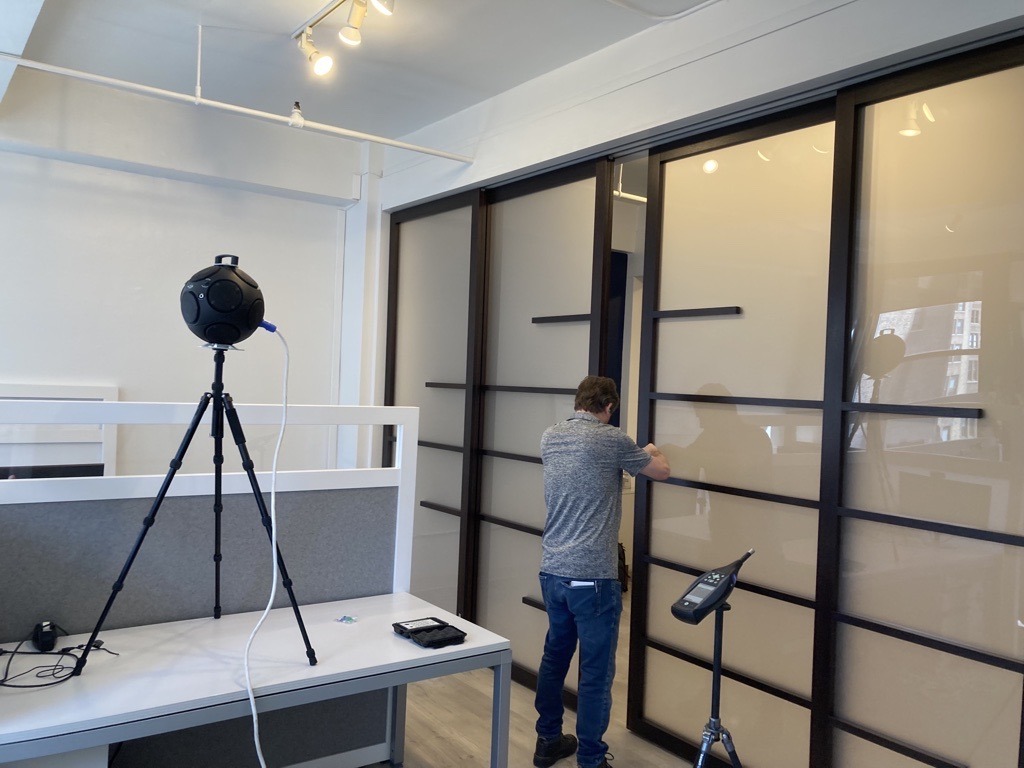
We recently undertook an effort to field-test sound transmission on a selection of our room dividing systems with an independent (3rd party) engineering firm. Field testing is especially important for us (and our clients) as the built environment tends to highlight any shortcomings more critically versus what you might find in laboratory testing. It also means the numbers reflected in the testing results provide a realistic expectation for those considering a room divider as a solution for their space.
Our findings from recent sound tests indicate an ASTC rating of 12- 15 for some of our more common large room dividers. To give that some background and context, ASTC is an acronym for “apparent sound transmission class” and measures how well a partition reduces sound, whether it be from exterior to interior (i.e. windows) or from one interior space to the next (like a wall or door). From the field conditions, our consultants were able to estimate an equivalent lab-setting rating for STC from 17-20 depending on system and configuration. With the right configurations and/or added sound attenuation items like gaskets, the numbers achieved can be even higher, meaning greater sound attenuation.
A 1 STC in sound reduction is roughly equivalent to approximately 1 decibel less – a 3 decibel drop is where change becomes a perceptible difference to the human ear. Sound reduction does not work equally for all frequencies, but the ones we are most concerned with are human speech (given that Raydoor is an interior product).
What STC Ratings Actually Mean in a Built Environment
A laboratory STC rating measures how a panel performs under controlled conditions; sealed chamber, level floors, no flanking paths. A field ASTC rating measures how that same panel performs once it’s installed in a real interior, with all the variables a real space introduces.
Those two numbers will always differ. Gaps around tracks, ceiling plenums, shared HVAC paths, and hard reflective surfaces all create routes for sound to travel that a lab test doesn’t account for.
For context, a standard interior stud wall with drywall typically achieves an STC of around 33-35. A Raydoor sliding system at STC 17-20 reduces noise meaningfully, enough to create a sense of separation and speech privacy between similar spaces, but it does not replicate the performance of a fixed structural wall. Understanding that distinction upfront leads to better specifications and better outcomes.
What Does It Mean for Expectations of Performance in a Project?
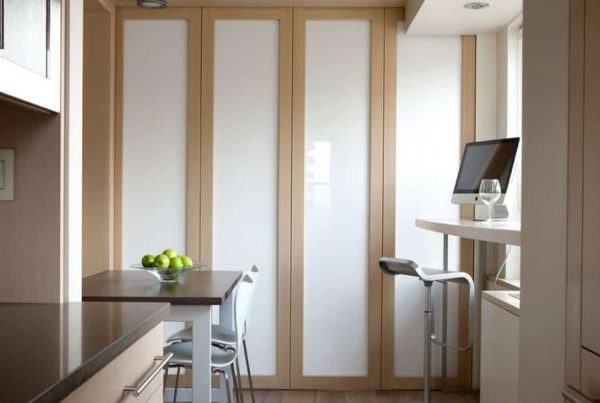
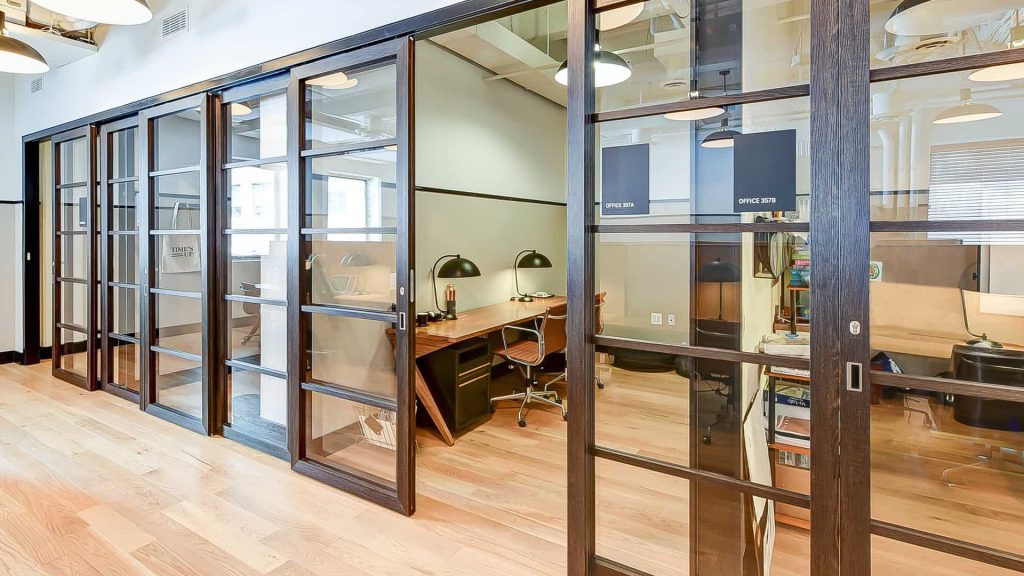
It boils down to specifying the right product for the right situation. With our product range we are ideally suited to separate spaces with similar functions on both sides of the system. Office from office, living room from den, servery from dining area are all good examples of where a Raydoor system might work best. It is important to keep in mind that Raydoor systems are very much aesthetic visual dividers – for situations that require the utmost in sound privacy they might not be ideal. That being said, discussing your needs with one of our design consultants can help us tailor solutions that serve a broad variety of needs beautifully.
Other Factors That Affect Acoustic Performance
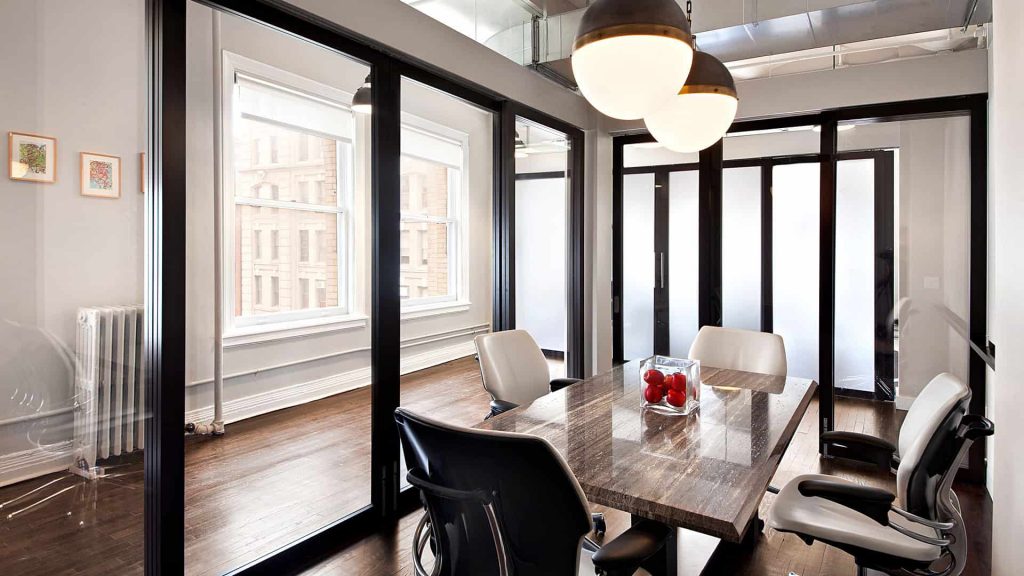
STC and ASTC ratings describe panel performance in isolation. In practice, several additional factors influence how much noise reduction a sliding room divider delivers in a real project:
- Ambient noise levels: A space with higher baseline noise on the open side (office chatter, HVAC hum, background music) will feel more acoustically private even with a lower-rated system. Conversely, a very quiet environment on both sides makes any gap in attenuation more noticeable.
- Room materials: Carpet, upholstered furniture, soft wall treatments, and acoustic ceiling panels all absorb sound within the room and reduce the amount that reflects and travels. A hard-surfaced room will perform worse acoustically than the STC rating alone would suggest.
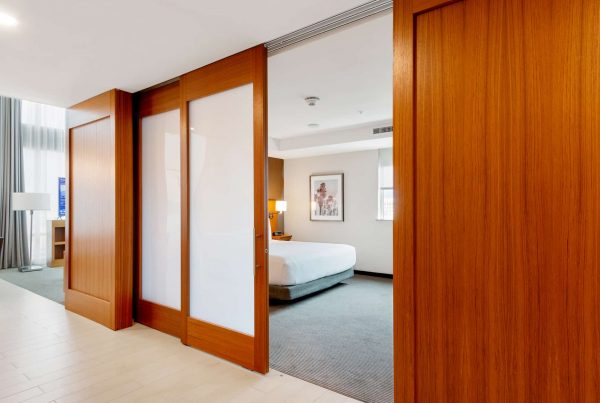
- Proportion of operable wall to fixed wall: A Raydoor system spanning a narrower opening within a larger fixed wall will perform better than a full-span divider stretched across a wide-open floor plate. The more of the separation handled by structural material, the less acoustic work the operable system has to do.
- Gaskets and seals: Certain Raydoor configurations can be fitted with added sound attenuation components that push performance above the baseline ASTC 12-15 figures recorded in field testing.
- Sound masking: Introducing ambient sound (white noise or low-level background audio) into a space raises the noise floor and makes speech from adjacent areas less intelligible, effectively improving perceived privacy without changing the panel specification at all.
Project Flexibility
Continuing the theme of customization, our inserts offer varying levels of visual privacy from completely transparent to opaque, with numerous levels in between and translucent or not as the space requires. We can also use more decorative inserts from the likes of Lumicor or 3-Form and can even accommodate custom artwork applied as film. Go really wild and make a different statement on each panel to create a kaleidoscopic effect as doors slide past one another or as they stack.
While there are certain standards and requirements as with any product, it has been Raydoor’s goal to provide designers and users with a tailored product that enhances a space and a design, even becoming a design feature if that’s preferred. Just as easily, Raydoor systems can be customized to blend seamlessly with their surroundings, sliding silently while providing added functionality without standing out. Let us help you achieve the goals of your project with the flexibility to make Raydoors your own in more ways than one.